Speed Limits in China: Default Limits, Bad Weather and Expressways
Speed signs always win. You may not exceed the limit shown on a sign or marking. The numbers below apply where there is no speed sign or marking, according to the Implementing Regulations.
Default maximum speeds without signs
| Road type | Urban road | Highway outside cities |
|---|---|---|
| No center line | 30 km/h | 40 km/h |
| Only one motor vehicle lane in your direction (with center line) | 50 km/h | 70 km/h |
The law also requires you to keep a safe speed on sections without limit signs, and to slow down at night, on dangerous road sections and in sandstorm, hail, rain, snow, fog or freezing conditions.
When the limit drops to 30 km/h
A motor vehicle may not exceed 30 km/h in these situations (tractors, battery cars and wheeled special machinery 15 km/h):
- Entering or leaving a non-motor vehicle lane, passing a railway crossing, a sharp bend, a narrow road or a narrow bridge
- Making a U-turn, turning or going down a steep slope
- Fog, rain, snow, dust or hail when visibility is within 50 m
- Driving on ice, snow or muddy roads
- Towing a broken-down motor vehicle
Expressways
| Rule | Value |
|---|---|
| Highest speed that may be posted | 120 km/h |
| Lowest speed that may be posted | 60 km/h |
| Small passenger cars | Not above 120 km/h |
| Other motor vehicles | Not above 100 km/h |
| Motorcycles | Not above 80 km/h |
| Two lanes in your direction | Left lane minimum 100 km/h |
| Three or more lanes in your direction | Leftmost lane minimum 110 km/h, middle lanes minimum 90 km/h |
If a speed sign says something different, follow the sign.
Following distance on expressways
- Above 100 km/h: keep at least 100 m from the vehicle ahead in the same lane.
- Below 100 km/h: the gap can be shorter but never less than 50 m.
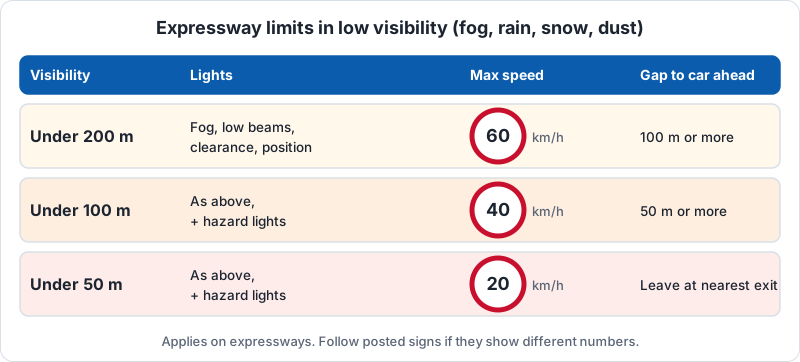
Low visibility on expressways
| Visibility | Lights | Maximum speed | Distance to the car ahead |
|---|---|---|---|
| Less than 200 m | Fog lights, low beams, clearance lights, position lights | 60 km/h | 100 m or more |
| Less than 100 m | Same, plus hazard lights | 40 km/h | 50 m or more |
| Less than 50 m | Same, plus hazard lights | 20 km/h | Leave the expressway at the nearest exit as soon as possible |
Lane etiquette
On roads with two or more lanes in one direction, the left lane is the fast lane and the right lane is the slow lane. A vehicle in the fast lane that cannot keep the required speed should move to the slow lane, and motorcycles keep to the right-most lane.
Practice
Try the speed questions in our mock exam (choose the “Speed and distance” topic). More on expressways: driving on Chinese expressways.
Other situations where you must go slowly
The law adds several general duties that do not have a fixed number:
- Keep a safe speed on road sections without speed limit signs. You are responsible for choosing a speed that lets you stop safely.
- Slow down at night, on dangerous road sections, and in sandstorms, hail, rain, snow, fog and freezing weather.
- Slow down at crosswalks. When pedestrians are on the crosswalk, stop to give way.
- Slow down in residential compounds and company yards. The Implementing Regulations say motor vehicles must drive at low speed and give way to pedestrians there. If a speed limit sign is posted, follow it.
- Slow down at roadworks. When passing a construction zone, watch the warning signs and reduce speed.
- Slow down at bends and crests. When approaching a sharp bend, the top of a slope or any place that limits your view, slow down and sound the horn if needed.
- Slow down for bad road surfaces. On snow, ice or mud the limit is 30 km/h.
Reading speed signs
A sign showing a number inside a red-bordered circle is a maximum speed. On expressways, signs often show a number for each lane. A sign showing a blue circle with a number is a minimum speed. Always follow the sign over the default numbers in the tables above.
How the limits apply to different vehicles
The expressway limits depend on the vehicle: small passenger cars up to 120 km/h, other motor vehicles up to 100 km/h and motorcycles up to 80 km/h. Tractors, battery cars and wheeled special machinery have much lower limits: they may not exceed 15 km/h in the situations that cap other vehicles at 30 km/h.
Common questions
Is there a speed tolerance? The sources we read do not describe any tolerance. Treat the posted limit as the limit.
How are speeding fines set? Fines are set in other regulations and by local police, and are not part of the rules quoted here.
What if I go below the minimum on an expressway? The rules set a minimum speed, and a vehicle in the fast lane that cannot keep the required speed must move to the slow lane. Driving too slowly in the fast lane is therefore also a problem.
Do the limits apply to foreign drivers? Yes. The Road Traffic Safety Law and its Implementing Regulations apply to all drivers in Chinese territory.