Driving on Chinese Expressways: Rules Every Foreign Driver Should Know
Expressways (高速公路) have their own rules in the Road Traffic Safety Law and its Implementing Regulations. The numbers below apply unless signs on the road say otherwise. Urban expressways (“fast roads”) are managed under the same rules.
Who may use an expressway
The law says pedestrians, non-motor vehicles, tractors, special wheeled mechanical vehicles, articulated buses, full trailers and other motor vehicles with a designed maximum speed below 70 km/h may not enter. Two-wheeled motorcycles may not carry passengers on expressways, and cargo trucks may not carry people in the cargo area.
Probationary drivers
In your first 12 months after getting a license, you may only drive on an expressway if you are accompanied by a driver who has held the same class of license (or a class including it) for at least three years. See probationary driver rules. Learning to drive and testing a vehicle on an expressway are both prohibited.
Speed
- The posted maximum can never be above 120 km/h. The posted minimum can never be below 60 km/h.
- Small passenger cars: up to 120 km/h. Other motor vehicles: up to 100 km/h. Motorcycles: up to 80 km/h.
- Expressways should show the speed for each lane. Where lane signs differ from the general rules, follow the signs.
- Minimum lane speeds: with two lanes in your direction, 100 km/h in the left lane. With three or more lanes, 110 km/h in the leftmost lane and 90 km/h in the middle lanes.
Details are in speed limits in China.
Distance from the car ahead
| Your speed | Minimum distance in the same lane |
|---|---|
| Above 100 km/h | At least 100 m |
| Below 100 km/h | May be shorter, but never less than 50 m |
Entering and leaving
- Entering from a ramp: switch on the left turn signal and enter the lane only if you do not obstruct vehicles already on the expressway.
- Leaving: switch on the right turn signal, move into the deceleration lane, slow down and then exit.
- Overtaking on ramps, acceleration lanes and deceleration lanes is banned.
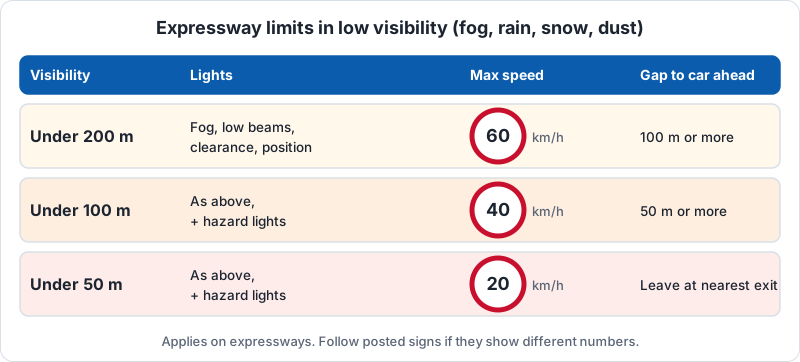
Low visibility: fog, rain, snow, dust, hail
When visibility is low, the expressway rules are stricter than on ordinary roads. Expressway managers should also publish speed limits and distance advice on electronic signs.
| Visibility | Lights | Maximum speed | Distance to the car ahead |
|---|---|---|---|
| Under 200 m | Fog lights, low beams, clearance lights, front and rear position lights | 60 km/h | 100 m or more |
| Under 100 m | Same, plus hazard lights | 40 km/h | 50 m or more |
| Under 50 m | Same, plus hazard lights | 20 km/h | Leave the expressway at the nearest exit as soon as possible |
What is prohibited
- Reversing, driving against traffic, crossing the central divider to turn around, or stopping in a lane
- Overtaking on a ramp, acceleration lane or deceleration lane
- Straddling the lane dividing lines or driving on the shoulder
- Driving or stopping in the emergency lane when it is not an emergency
- Testing a vehicle or learning to drive
The law also forbids anyone but police on emergency duty from stopping and checking vehicles on an expressway.
If your car breaks down
- Move the car out of traffic if you can, and keep your hazard warning lights on.
- If you cannot move it, place a warning sign more than 150 m behind the vehicle (in the direction traffic comes from). On ordinary roads the Implementing Regulations require only 50 to 100 m.
- Get everyone out to the right-hand shoulder or the emergency lane, and report to the police.
- A vehicle that cannot move because of a breakdown or accident must be towed or hauled away by a rescue vehicle. Call for a rescue service rather than arranging a tow yourself.
Roadworks
When you pass a construction zone on an expressway or any road, watch the warning signs and slow down.
Before a long drive
- Check tyres, lights and fuel. The law requires drivers to check the safety and technical performance of the vehicle before driving.
- Do not drive more than four hours without a break. After four hours you must stop and rest for at least 20 minutes.
- Do not use a handheld phone while driving.
Practice
The mock exam includes an “Expressways” topic with questions on speed, distance and ramps.
Sources
- Regulation on the Implementation of the Road Traffic Safety Law (道路交通安全法实施条例), Articles 78-85
- Road Traffic Safety Law of the PRC, English translation (Supreme People's Court English site), special provisions on expressways
- Provisions on the Application for and Use of Motor Vehicle Driving Licenses (机动车驾驶证申领和使用规定), Article 77