Parking and Stopping Rules in China: Where You Must Not Park
Cities in China often enforce parking rules with cameras, so it pays to know the basics. The rules below are about temporary parking on roads in the Implementing Regulations and the Road Traffic Safety Law. Cities may add their own restrictions, such as time limits and paid parking, so always read the signs and the lines on the road.
General rule
Motor vehicles must park in designated places. They may not park on sidewalks, except in parking spaces marked there under the law. A vehicle parked temporarily on the road must not obstruct other vehicles or pedestrians.
City governments may mark parking spaces on urban roads, as long as they do not obstruct pedestrians and vehicles, and they may set the hours when each space can be used. So a space that is free at night may be restricted during the day.
Places where you may not stop
| Where | Rule |
|---|---|
| Road sections with no-parking signs or markings | No stopping |
| Roads where a barrier separates the motor vehicle lane from a non-motor vehicle lane or sidewalk | No stopping |
| Crosswalks | No stopping |
| Construction zones | No stopping |
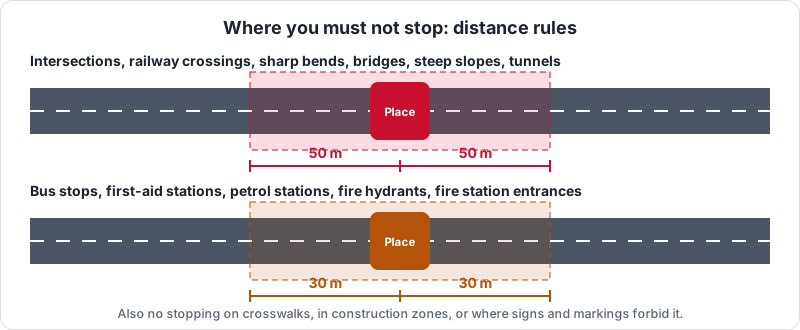
| Intersections, railway crossings, sharp bends, roads narrower than 4 m, bridges, steep slopes, tunnels | No stopping, and none within 50 m of them |
| Bus stops, first-aid stations, petrol stations, fire hydrants, the entrances to fire stations | No stopping within 30 m, unless you are using the facility |
Distances matter. The 50 m and 30 m rules apply to the stretch of road within that distance of the place named.
How to park at the curb
- Park as close to the right-hand edge of the road as you can.
- Do not leave the vehicle. The rule says the driver must not leave the car when parked temporarily at the roadside and should drive away right after people have got out or goods have been loaded.
- Do not open the doors, or let people get in or out, until the vehicle has stopped completely.
- Opening or closing a door must not obstruct other vehicles or pedestrians. Check mirrors and behind you first.
- Switch on your right turn signal in advance when pulling in to the curb.
- City buses may not stop to let passengers on or off anywhere other than at bus stops.
Waiting in queues and at jammed intersections
- If the intersection ahead is jammed, stop in line outside the intersection. Do not enter.
- When vehicles ahead are queued or moving slowly, line up behind them. Do not squeeze past on either side.
- Do not stop on a crosswalk or in a grid-marked (net) area while waiting.
- Where lanes decrease, take turns, one vehicle from each lane in alternation.
If your car breaks down
- Switch on your hazard warning lights.
- If the vehicle blocks traffic and is hard to move, put a warning sign 50 to 100 m behind the vehicle on an ordinary road. At night also turn on the clearance (outline) lights and position lights.
- On an expressway, the sign goes more than 150 m behind the vehicle. See driving on Chinese expressways.
- If you need a tow, the rules for towing a broken-down vehicle say the towed vehicle may carry only its driver and no trailer, the towed vehicle may be no wider than the towing vehicle, both vehicles must have hazard lights on, and with a soft towing link the gap must be more than 4 m and less than 10 m. A vehicle whose steering, lighting or signals have failed must be moved by a special tow truck.
U-turns and reversing
- U-turns are banned where a sign or marking prohibits them or prohibits left turns, and at railway crossings, crosswalks, bridges, sharp bends, steep slopes, tunnels and other dangerous places. Where nothing prohibits them, you may turn around but must not obstruct other traffic or pedestrians.
- Reversing is banned at railway crossings, intersections, one-way streets, bridges, sharp bends, steep slopes and tunnels. Check the situation behind the vehicle first.
Flooded roads
If you reach a flooded road or bridge, stop and check how deep the water is. Cross at low speed only if it is safe. Do not park in water-filled low spots.
Tips for visitors
- Look for signs showing the hours when a space may be used. A circular sign with a red border is a prohibition sign.
- Do not stop to take photos on the road. Use a parking lot or a designated stopping area.
- If you are not sure whether a place is legal, find a car park.
Practice
Try the “Safe driving” topic in the mock exam, which has questions on the 30 m and 50 m rules.