Chinese Traffic Lights and Signals Explained for Foreign Drivers
China uses nationwide traffic signals. The rules are set in the Road Traffic Safety Law and its Implementing Regulations. Here is what each signal means for a driver.
The order of priority
Under the Road Traffic Safety Law, vehicles and pedestrians follow traffic lights. When a traffic police officer is directing traffic, you follow the officer’s directions. Where there are no signals, you follow the principles of safety and unimpeded traffic.
Motor vehicle signal lights
| Signal | Meaning |
|---|---|
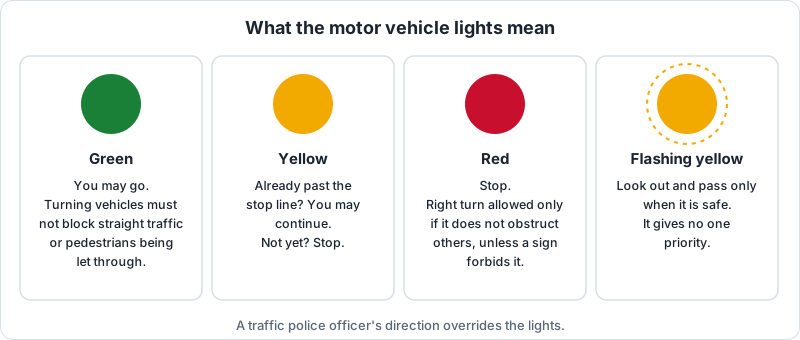
| Green | You may go. Turning vehicles must not obstruct straight-going vehicles or pedestrians who are being let through |
| Yellow (steady) | Vehicles that have already crossed the stop line may continue. Others stop |
| Red | Vehicles may not pass |
| Flashing yellow | A continuously flashing yellow light reminds drivers and pedestrians to look out and pass only after confirming it is safe. It does not give anyone priority |
Turning right on red
Unless a sign or signal says otherwise, a right-turning vehicle may go at a red light when it does not obstruct vehicles or pedestrians that are being let through. Slow down, stop if needed and give way. Some intersections have dedicated right-turn arrows or signs forbidding the turn: follow those.
Direction arrows
Arrow lights that point left, up or right mean turn left, go straight or turn right, respectively. Where an intersection has guide lanes, you must enter the lane for the direction you want.
Lane signal lights
Used over reversible or special lanes:
- Green arrow: vehicles in this lane may go in the direction shown.
- Red cross or red arrow: vehicles in this lane may not go.
Pedestrian signals
A green pedestrian light lets pedestrians cross. At red, pedestrians must not enter the crosswalk, but those already on it may continue or wait at the center line of the road. When a pedestrian is on a crosswalk, drivers must slow and stop to let them pass.
Railway crossing lights
Two alternating red lights or one steady red light means vehicles and pedestrians may not cross. When the red light goes out, crossing is allowed. Where there is no signal or staff, a driver must slow down or stop and cross only when sure it is safe.
Types of signs and markings
The Implementing Regulations list these categories:
- Traffic signs: indication (mandatory) signs, warning signs, prohibition signs, direction (guide) signs, tourist area signs, road works safety signs and auxiliary signs.
- Road markings: indication markings, warning markings and prohibition markings.
- Police directions: hand signals and signals made with equipment.
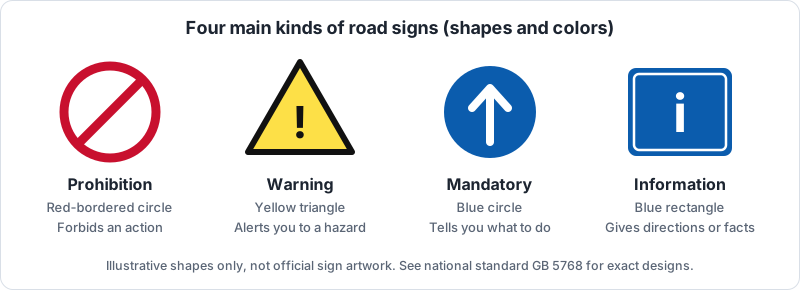
Sign shapes and colors follow national standard GB 5768. In general, prohibition signs are circles with a red border, warning signs are yellow triangles with a black border, mandatory signs are blue circles, and information signs are blue rectangles. On the road, a solid yellow line separates traffic traveling in opposite directions, and you must not cross it. A white dashed line between lanes in the same direction permits lane changes when it is safe.
Practice
Test yourself with our mock exam. Next, read right of way and intersections.
More detail on each signal type
The Implementing Regulations divide traffic signal lights into seven kinds: motor vehicle signal lights, non-motor vehicle signal lights, crosswalk (pedestrian) signal lights, lane signal lights, direction arrow lights, flashing warning lights, and signal lights at railway crossings. Where there is no separate non-motor vehicle light or pedestrian light at an intersection, cyclists and pedestrians follow the motor vehicle light.
Roadworks and temporary signals
Road maintenance crews must place standard warning signs and protective facilities. Maintenance vehicles must carry warning lights, and they use the warning lights and hazard lights while working. If a road must be closed for works, the authorities announce it five days in advance, except in emergencies. If vehicles must detour, the construction unit places signs at the detour point.
Crosswalks and sound signals
Intersections and busy pedestrian stretches should have crosswalks, pedestrian bridges or underpasses. Where many blind people walk, crosswalk lights should have a sound signal. In front of schools, kindergartens, hospitals and homes for the elderly, the law says crosswalks and standby signs should be provided.
Dangerous road sections
Sharp bends, steep slopes, cliff edges and waterside sections should have warning signs and safety barriers set to national standard. If signs or markings are confusing, the road authorities must improve them.
Traffic police directions
The Implementing Regulations recognize two kinds of police directions: hand signals and signals given with equipment. The Road Traffic Safety Law says that when a traffic police officer directs traffic at the scene, drivers must follow the officer’s direction, even if it differs from the lights.
Tips for foreign drivers
- Look for the arrow lights before you turn. Left, up and right arrows control left turn, straight and right turn separately.
- Do not enter an intersection if you cannot clear it. Waiting outside is the rule when the junction is jammed.
- Give way to pedestrians and cyclists even on a green light. Turning vehicles must not obstruct those being let through.
- Do not speed up for a yellow light. The rule says only vehicles that have already crossed the stop line may continue through a yellow light. Others must stop.
- Watch for dedicated right-turn lights. Where there is a right-turn arrow or a sign forbidding a right turn on red, follow it.